

Why most mental health clinics fail within 5 years — and the operational gaps nobody talks about
Key takeaways
- Prior authorization reform is now live: under CMS-0057-F, payers must issue urgent decisions within 72 hours and standard decisions within 7 calendar days — but faster responses only benefit clinics whose submissions are already clean.
- Becker’s Behavioral Health documented 18 behavioral health closures in 2025 and a further wave in 2026. The stated causes are consistently financial and administrative, not clinical.
- According to a KFF consumer survey, one in five insured adults who used mental health services reported a denied claim — the same rate as emergency room visits, and substantially above most other care types.
- As of December 2025, 40% of the US population — approximately 137 million people — lives in a Mental Health Professional Shortage Area (HRSA). Clinics that close in those communities are not easily replaced.
- CMS-0057-F Phase 2, requiring FHIR-based Prior Authorization APIs, takes effect January 2027. Whether a clinic’s EHR supports that integration is an operational question that needs an answer now.
The reform that changes the equation
On 1 January 2026, the first operational phase of CMS-0057-F — the CMS Interoperability and Prior Authorization Final Rule — came into effect. According to CMS, covered payers must now issue urgent prior authorizations decisions within 72 hours and standard decisions within 7 calendar days, replacing timelines that commonly ran 14 to 30 days. A second phase requiring FHIR-based Prior Authorization APIs takes effect 1 January 2027.
The reform is real. The relief is not automatic.
A clinic still running disconnected billing systems, manual authorizations workflows, and documentation not structured for payer review will not benefit from faster timelines. It will receive faster denials. The four operational gaps that quietly erode behavioral health clinics — in revenue cycle management, care coordination, documentation, and compliance readiness — were survivable when a prior auth decision took three weeks. They are not, when it takes seven days.
What the closure data actually shows
Becker’s Behavioral Health documented 18 behavioral health closures in 2025 and a further wave in 2026. The stated reasons — financial losses tied to Medicaid billing failures, reimbursement rate cuts, inability to sustain operations — are consistently operational, not clinical. Philadelphia-based Wedge Recovery Centers, which operated seven clinics, closed after three years of financial losses attributable to declining Medicaid enrollment and rising overhead costs. Laurel Ridge Treatment Center in San Antonio lost its Medicare provider agreement after CMS cited failure to comply with health and safety participation requirements, triggering layoffs of approximately 648 employees.
The pattern is consistent. Behavioral health clinic failures are almost never clinical failures. They are systems failures.
According to HRSA’s December 2025 State of the Behavioral Health Workforce report, 40% of the US population, approximately 137 million people, live in a Mental Health Professional Shortage Area. The clinics that close in those communities are not easily replaced.
Gap 1: Billing infrastructure that was not designed for behavioral health
Behavioral health billing operates under a distinct set of rules. Every individual session must independently establish medical necessity unlike most medical specialties, where a diagnosis drives a treatment plan and visit-level documentation faces less scrutiny. Time-based CPT codes such as 90832, 90834, and 90837 are among the most frequently audited in the entire claims ecosystem.
A KFF consumer survey found that one in five insured adults who used mental health services reported a denied claim. An analysis of commercial plan data cited by the American Association of Medical Colleges found that one in five medically necessary behavioral health claims were denied in 2020. The Journal of AHIMA puts the administrative cost to rework a denied claim at $25 for physician practices and up to $181 for hospitals — and a significant share of denials are never resubmitted at all, representing permanent revenue loss.
The clinics most exposed to this gap are those using general-purpose medical billing systems retrofitted with behavioral health fields. The manual workarounds those systems require such as tracking payer-specific authorizations rules outside the platform, managing modifier requirements separately etc. create the coding inconsistencies that produce denials in the first place.
Gap 2: Care coordination that lives outside the clinical record
When care coordination activity runs through spreadsheets, email threads, or staff memory rather than through the clinical record, two things happen simultaneously: outcomes suffer and the documentation that justifies ongoing treatment becomes impossible to produce at the point of need.
Payers reviewing prior authorizations requests are not simply checking whether a service was delivered. They are reviewing whether the clinical rationale — the connection between the intake assessment, the treatment plan, and the current progress note — is legible within the record itself. In multi-provider settings, when a prescriber, therapist, and care coordinator are each documenting in separate systems, that integrated picture cannot be assembled quickly.
What genuinely integrated care coordination looks like in practice — and what it costs when the gaps stay open — is examined in detail in Closing the gaps: how integrated care coordination saves time, money and lives.
Gap 3: Documentation workflows that create payer exposure
Documentation burden is a workforce problem and a compliance problem, and in 2026 they are the same problem. HRSA’s December 2025 State of the Behavioral Health Workforce report identifies reimbursement challenges and clinician burnout as the key provider-level barriers preventing behavioral health clinicians from performing at full capacity. When documentation is slow and structurally incomplete, clinicians spend uncompensated time completing notes after hours — notes more likely to be flagged for missing functional impairment data or measurable progress markers.
Payers are now deploying AI-driven claims analysis to identify notes that lack those specific elements. A progress note missing a functional status update can trigger retroactive denial across multiple sessions. The issue is not note length. It is note structure.
What high-performing clinics do differently is build documentation templates around what payers actually require, not clinical preference alone. Platforms purpose-built for behavioral health, such as integrated care management systems like blueBriX’s behavioral health EHR, are designed to connect clinical documentation, billing, and care coordination in one workflow. That integration is what makes audit-ready notes a standard output rather than a reactive response to a denial.
Gap 4: Compliance infrastructure that responds to policy, not audits
The regulatory environment in 2026 is not stable. The Trump administration announced in May 2025 it would not enforce the strengthened 2024 MHPAEA parity regulations, while regulators simultaneously signaled more aggressive parity audits around non-quantitative treatment limitations — prior authorization criteria, network adequacy, and medical necessity standards. Updated 42 CFR Part 2 rules governing substance use disorder records took full effect February 16, 2026, adding documentation obligations many clinics are still absorbing.
Clinics whose compliance posture is reactive — adjusting workflows after a denial, updating documentation standards after an audit — will consistently be operating behind this curve. A systematic review published in The American Journal of Medicine (Johns Hopkins Medicine, September 2025) found that across 11 behavioral health studies, prior authorization delays are linked to treatment interruptions, higher relapse rates, and worse outcomes for patients with psychiatric illness or substance use disorder. The clinical consequences of compliance failure reach patients before they appear in revenue reports.

What high-performing clinics do differently
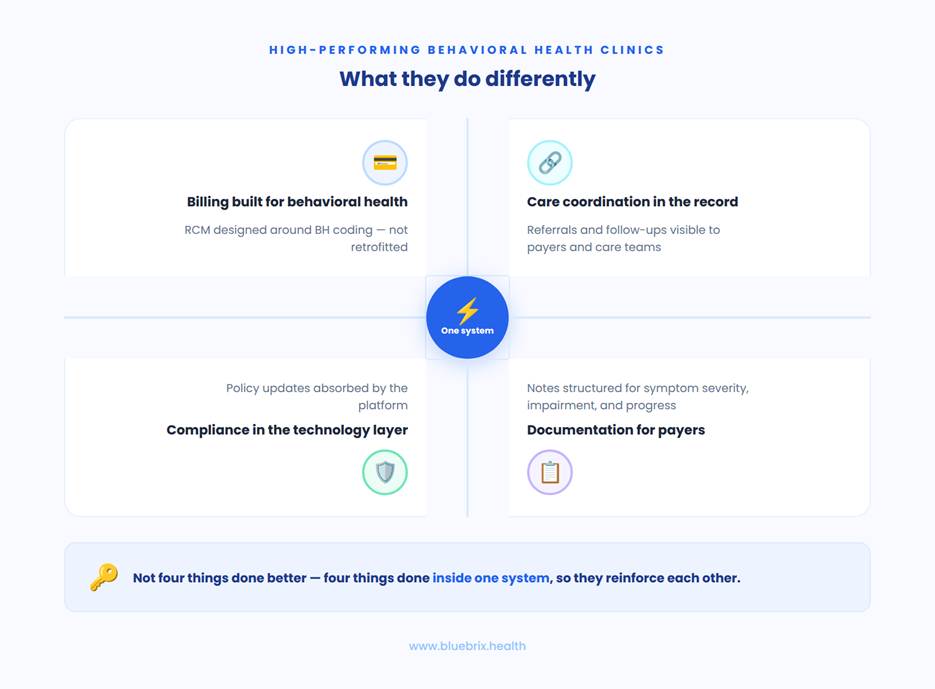
The clinics navigating 2026 successfully share a recognizable pattern. Billing tools are designed for behavioral health coding requirements, not adapted from general medicine. Care coordination is visible within the clinical record. Documentation workflows are built around payer review criteria. Compliance infrastructure is maintained by the technology layer, not by manual staff effort.
The common failure is treating each gap as a separate problem requiring a separate tool. The operational fragmentation that results — billing in one system, documentation in another, coordination in a third — is itself what makes the other four gaps permanent.
Behavioral health clinic closures are rarely caused by poor care. They are caused by excellent clinical programs built on operational infrastructure that was never designed to sustain them financially. CMS-0057-F’s 2026 deadlines did not create that problem. They removed the buffer that allowed it to persist.
The bottom line
Behind every operational gap is a patient who did not get the care they needed — because a prior auth was delayed, a claim was denied, or a clinic could no longer afford to stay open. The four gaps in this article are fixable. They require deliberate investment in the right infrastructure, not heroic effort from already stretched clinical teams. Getting the operations right is not a business decision separate from the mission. In behavioral health, it is the mission. Recognising which of the four gaps is costing the most is the starting point. Acting on it, with systems designed specifically for behavioral health rather than adapted from general medicine, is what separates the clinics still operating in five years from those that are not.
Frequently asked questions
What does CMS-0057-F require from behavioral health providers in 2026?
The January 2026 phase places obligations on payers, not directly on providers. According to CMS, covered payers must now issue urgent prior authorizations decisions within 72 hours and standard decisions within 7 calendar days, and must give specific denial reasons. The practical implication for providers is that incomplete submissions no longer have weeks to be corrected — documentation must be complete at the point of submission.
Why are behavioral health clinics closing if demand for services is rising?
Rising demand does not protect a clinic with operational gaps. Becker’s Behavioral Health reporting shows closures in 2025 and 2026 are consistently tied to financial and administrative causes — Medicaid billing failures, overhead costs, reimbursement shortfalls — rather than low patient volume. Demand and financial viability are separate variables in behavioral health.
What is the FHIR prior authorizations API requirement and when does it affect providers?
CMS-0057-F Phase 2, effective January 2027, requires covered payers to implement FHIR-based Prior Authorization APIs conforming to the HL7 Da Vinci standard. When operational, providers using a compatible EHR will be able to submit prior authorizations requests directly from their clinical workflow. The question for providers now is whether their EHR will support this integration before the deadline.
How does documentation structure affect prior authorizations outcomes?
In behavioral health, every session must independently establish medical necessity. Payers and their AI-driven review systems are checking for measurable symptom severity, functional impairment data, and documented progress toward treatment goals. A note that is clinically accurate but structurally incomplete is treated as an undocumented service. Note structure — not just content — is a direct revenue variable.
Author Bio

Shahzad Mohammad
Chief Product Officer
Shahzad Mohammad is Co-founder and Chief Product Officer at blueBriX, where he has played a central role in shaping the platform from day one. He helped turn a vision for accessible, customizable digital health tools into reality. Passionate about reducing complexity and empowering care teams, Shahzad focuses on building technology that improves patient outcomes and accelerates healthcare innovation.
LinkedIn Profile: https://www.linkedin.com/in/shahzad-mohammad-7646b014/