

Professionelle Gesichtsbehandlungen – Der Schlüssel zu gesunder und strahlender Haut
Unsere Haut ist täglich zahlreichen Belastungen ausgesetzt. Umweltverschmutzung, UV-Strahlung, Stress, hormonelle Veränderungen und eine ungesunde Lebensweise können dazu führen, dass der Teint fahl wirkt, Poren verstopfen oder erste Zeichen der Hautalterung sichtbar werden. Obwohl eine regelmäßige Pflegeroutine zu Hause wichtig ist, reicht sie häufig nicht aus, um die Haut langfristig gesund und gepflegt zu erhalten. Genau hier setzen professionelle Gesichtsbehandlungen an.
Immer mehr Menschen informieren sich über eine Gesichtsbehandlung Frankfurt, um ihre Haut gezielt pflegen zu lassen und individuelle Hautprobleme professionell behandeln zu können. Moderne kosmetische Behandlungen kombinieren wissenschaftlich fundierte Methoden mit innovativen Technologien und sorgen für sichtbare sowie nachhaltige Ergebnisse.
Warum ist eine professionelle Gesichtsbehandlung sinnvoll?
Die Haut erneuert sich zwar kontinuierlich selbst, dennoch können abgestorbene Hautzellen, überschüssiger Talg und Umwelteinflüsse diesen natürlichen Prozess beeinträchtigen. Die Folge sind vergrößerte Poren, Unreinheiten, Mitesser oder ein müder Teint.
Eine professionelle Gesichtsbehandlung verfolgt deshalb mehrere Ziele gleichzeitig:
- Gründliche Reinigung der Haut
- Entfernung abgestorbener Hautzellen
- Verbesserung der Hautdurchblutung
- Intensive Feuchtigkeitsversorgung
- Anregung der Kollagenproduktion
- Vorbeugung vor vorzeitiger Hautalterung
Im Gegensatz zu herkömmlichen Pflegeprodukten wird jede Behandlung individuell auf den Hauttyp abgestimmt. Dadurch lassen sich sowohl trockene als auch fettige oder empfindliche Haut optimal behandeln.
Die Bedeutung einer professionellen Gesichtsreinigung
Ein besonders wichtiger Bestandteil moderner Hautpflege ist die professionelle Gesichtsreinigung Frankfurt. Viele Menschen reinigen ihr Gesicht zwar täglich, doch selbst hochwertige Produkte können tief sitzende Verunreinigungen oft nicht vollständig entfernen.
Während einer professionellen Behandlung werden unter anderem:
- überschüssiger Talg entfernt,
- verstopfte Poren gereinigt,
- Mitesser und Hautunreinheiten behandelt,
- abgestorbene Hautzellen schonend gelöst,
- pflegende Wirkstoffe tief in die Haut eingeschleust.
Gerade eine Tiefenreinigung Gesicht verbessert nicht nur das Hautbild, sondern sorgt auch dafür, dass Seren und Pflegeprodukte anschließend deutlich besser aufgenommen werden können.
Wer unter wiederkehrenden Hautunreinheiten leidet, profitiert häufig zusätzlich von einer professionellen Ausreinigung Gesicht, bei der Mitesser und verstopfte Poren besonders schonend entfernt werden.
Moderne Behandlungsmethoden für unterschiedliche Hautbedürfnisse
Die kosmetische Medizin hat sich in den vergangenen Jahren erheblich weiterentwickelt. Moderne Technologien ermöglichen heute besonders schonende Behandlungen mit kurzen Regenerationszeiten und überzeugenden Ergebnissen.
Zu den beliebtesten Verfahren zählen unter anderem:
- Hydrafacial
- Microneedling
- Radiofrequenz
- Ultraschallbehandlungen
- Fruchtsäurepeelings
- Laserbehandlungen
Je nach Hautzustand empfiehlt die Kosmetikerin eine individuell abgestimmte Kombination verschiedener Behandlungsmethoden.
Hydrafacial – Tiefenreinigung und Feuchtigkeit in einer Behandlung
Eine der bekanntesten Innovationen ist das REVIDERM Hydrafacial. Diese Behandlung kombiniert mehrere Pflegeschritte in nur einer Sitzung.
Dabei wird die Haut:
- sanft gereinigt,
- gepeelt,
- von Unreinheiten befreit,
- intensiv mit Feuchtigkeit versorgt,
- mit wertvollen Antioxidantien gepflegt.
Das Ergebnis ist ein frischer, ebenmäßiger und strahlender Teint – ganz ohne lange Ausfallzeiten.
Hydrafacial eignet sich besonders bei:
- trockener Haut,
- empfindlicher Haut,
- großen Poren,
- unreiner Haut,
- ersten Fältchen,
- Pigmentflecken.
Microneedling – Natürliche Hauterneuerung
Ein weiteres modernes Verfahren ist das REVIDERM Microneedling.
Hierbei werden mit feinen Nadeln kontrollierte Mikrokanäle in der Haut erzeugt. Dadurch wird die natürliche Regeneration angeregt und die Produktion von Kollagen und Elastin stimuliert.
Microneedling kann helfen bei:
- Aknenarben,
- feinen Linien,
- Falten,
- großen Poren,
- Pigmentstörungen,
- erschlaffter Haut.
Da körpereigene Regenerationsprozesse aktiviert werden, verbessert sich das Hautbild oft noch Wochen nach der Behandlung weiter.
Gesichtsbehandlungen sind längst nicht mehr nur für Frauen
Auch Männer legen heute zunehmend Wert auf ein gepflegtes Erscheinungsbild. Deshalb steigt die Nachfrage nach einer Gesichtsbehandlung Männer Frankfurt kontinuierlich an.
Männerhaut unterscheidet sich deutlich von Frauenhaut. Sie produziert mehr Talg, ist meist dicker und wird durch die tägliche Rasur zusätzlich beansprucht.
Professionelle Behandlungen helfen dabei,
- Rasurbrand zu reduzieren,
- eingewachsene Haare vorzubeugen,
- große Poren zu verkleinern,
- fettige Haut zu regulieren,
- die Haut intensiv mit Feuchtigkeit zu versorgen.
Aus diesem Grund entscheiden sich immer mehr Männer regelmäßig für professionelle kosmetische Behandlungen, um ihre Haut langfristig gesund und gepflegt zu halten.
nnovative Technologien für langfristige Hautverbesserung
Neben klassischen Gesichtsbehandlungen stehen heute zahlreiche moderne Verfahren zur Verfügung, die gezielt auf unterschiedliche Hautprobleme eingehen. Dabei kommen innovative Technologien zum Einsatz, die nicht nur das Hautbild verbessern, sondern auch die natürliche Regeneration der Haut fördern.
Eine Ultraschall Gesichtsbehandlung nutzt hochfrequente Schallwellen, um Wirkstoffe tiefer in die Haut einzuschleusen und gleichzeitig die Mikrozirkulation anzuregen. Dadurch wirkt die Haut frischer, glatter und besser mit Feuchtigkeit versorgt.
Ebenso erfreut sich die Laser Gesichtsbehandlung wachsender Beliebtheit. Moderne Lasersysteme können Pigmentflecken reduzieren, feine Linien glätten und das Hautbild sichtbar verfeinern. Da unterschiedliche Lasertechnologien verschiedene Hautprobleme behandeln, erfolgt vor jeder Behandlung eine ausführliche Hautanalyse.
Medizinisch-ästhetische Verfahren für anspruchsvolle Haut
Viele Menschen wünschen sich heute sichtbare Ergebnisse ohne operative Eingriffe. Deshalb gewinnen minimalinvasive und medizinisch-ästhetische Behandlungen immer mehr an Bedeutung.
Zu den bekanntesten Verfahren gehören:
- PRX-T33 Fruchtsäurepeeling
- GREEN PEEL Kräuterschälkurbehandlung
- REVIDERM Radiofrequenz
- CO₂ Fraktionierter Laser
- HIFU Ultraschall Lifting
Das PRX-T33 Fruchtsäurepeeling regt die Hauterneuerung an, ohne die obere Hautschicht stark abzuschälen. Dadurch eignet sich die Behandlung hervorragend zur Verbesserung von Pigmentflecken, Aknenarben und ersten Fältchen.
Die GREEN PEEL Kräuterschälkurbehandlung basiert auf einer natürlichen Kräutermischung und unterstützt die Haut dabei, sich selbst zu regenerieren. Besonders bei unreiner Haut, sonnengeschädigter Haut oder einem müden Teint wird diese Methode häufig empfohlen.
Mit der REVIDERM Radiofrequenz kann die Kollagenproduktion zusätzlich stimuliert werden. Die Wärmeenergie sorgt für eine Straffung des Gewebes und verbessert die Hautelastizität auf natürliche Weise.
Für ausgeprägtere Hautveränderungen wird häufig der CO₂ FRAKTIONIERTE LASER eingesetzt. Diese Technologie kann Aknenarben, Falten sowie Sonnenschäden deutlich reduzieren und sorgt langfristig für eine glattere Hautstruktur.
Auch das HIFU ULTRASCHALL LIFTING gehört inzwischen zu den gefragtesten Anti-Aging-Behandlungen. Mithilfe fokussierter Ultraschallenergie werden tiefere Hautschichten stimuliert, wodurch ein natürlicher Straffungseffekt entsteht – ganz ohne Operation.
Die richtige Hautpflege endet nicht nach der Behandlung
Professionelle Behandlungen erzielen die besten Ergebnisse, wenn sie durch eine konsequente Hautpflege im Alltag ergänzt werden.
Experten empfehlen:
- Gesicht morgens und abends reinigen
- Sonnenschutz täglich verwenden
- Ausreichend Wasser trinken
- Hochwertige Pflegeprodukte nutzen
- Auf den individuellen Hauttyp abgestimmte Produkte wählen
- Regelmäßige professionelle Hautanalysen durchführen lassen
Eine gesunde Lebensweise mit ausreichend Schlaf, einer ausgewogenen Ernährung und wenig Stress unterstützt zusätzlich die Hautgesundheit.
Worauf sollte man bei der Wahl eines Kosmetikstudios achten?
Nicht jede Behandlung ist für jeden Hauttyp gleichermaßen geeignet. Deshalb beginnt jede hochwertige kosmetische Behandlung mit einer ausführlichen Beratung und Hautanalyse.
Wichtige Kriterien bei der Auswahl eines Studios sind:
- Qualifizierte Kosmetikerinnen
- Moderne Behandlungstechnologien
- Individuelle Beratung
- Hohe Hygienestandards
- Transparente Preise
- Positive Kundenbewertungen
- Regelmäßige Weiterbildung des Fachpersonals
Wer sich für eine Gesichtsbehandlung Frankfurt interessiert, sollte darauf achten, dass die Behandlung individuell auf die Bedürfnisse der Haut abgestimmt wird und moderne Verfahren zum Einsatz kommen.
Darüber hinaus bieten viele spezialisierte Studios heute innovative Signature Treatments an. Diese kombinieren verschiedene Technologien wie Hydrafacial, Microneedling, Radiofrequenz oder PRX-T33, um die Haut umfassend zu pflegen und langfristig zu regenerieren.
Neben klassischen Gesichtsbehandlungen gehören häufig auch IPL-Haarentfernung, Permanent Make-up, Wimpernbehandlungen, Nagelpflege sowie medizinisch-ästhetische Anwendungen zum Leistungsangebot moderner Kosmetikstudios. Wer sich einen Überblick über verschiedene professionelle Beauty-Behandlungen in Frankfurt verschaffen möchte, sollte auf Anbieter setzen, die individuelle Beratung mit innovativen Behandlungskonzepten verbinden.
What are the Symptoms and Treatment of Jaundice?
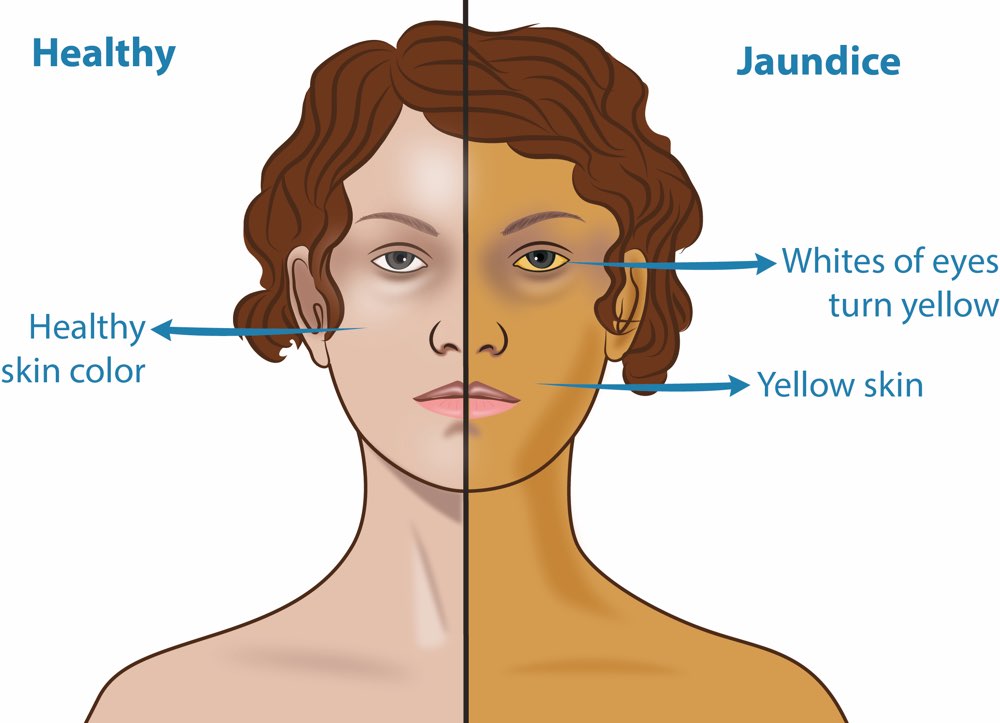
In this article, we examine the symptoms and treatment of jaundice. But first, we need to discuss what jaundice is. The term jaundice stands for the change that occurs in the sclera (white membrane in our eye) turning yellow. It is caused due to the rapid increase in bilirubin, which is yellow-orange bile pigment. Bile is the fluid production in our liver. Bilirubin is also a waste material in our blood. In a report, it is confirmed that about 60 percent of newborn babies in the United States have jaundice. So, it is the major problem in the U.S.(United States).
As we know jaundice is related to the functioning process of the liver. So, we need to maintain our liver in some ways like eating a healthy diet, not drinking too much (or more than the recommendation), exercise regularly, and yoga (which helps our digestion and immune system in making better).
There are three types of jaundice based on their occurrence
Hepatocellular jaundice occurs due to injury or disease in the liver.
Hemolytic jaundice occurs due to sudden breakdown of RBCs or rise in bilirubin.
Any kind of obstruction in the bile duct causes this condition called jaundice.
There are two types of jaundice Based on patient age.
- Adult jaundice, in which the patient is an adult.
- Newborn jaundice, in which patient is newborn
Symptoms of Jaundice
Many studies show that people have jaundice but don’t show any of the symptoms related to jaundice. In this part of the article, we discuss all such cases regarding jaundice symptoms.
It is an accidental case when the person has jaundice but doesn’t show any of the symptoms of jaundice.
The Following are the symptoms related to jaundice in the human body.
The most common symptoms of jaundice include.
- Sudden change in our skin and eye’s white membrane (sclera) color to yellow, Pale stools, Urine goes dark, Itchiness produces in our skin
- Accompanying symptom of jaundice which is due to low bilirubin levels include Fatigue, pale stool, darkness in urine, fever, vomiting. Unfortunately, weight loss, pain production our abdominal
Now, we describe the symptoms as per the basis of infection, if a person is infected then the person shows symptoms such as fever, abdominal pain, itchiness, and flu-like symptoms. If the person isn’t infected then such symptoms occur like weight loss, itchy skin.
If the jaundice is caused by liver-related disease, inflammation occurs.
Here you study the symptoms from many factors after that we study how to treat jaundice? and how to diagnose jaundice?
Treatment of Jaundice
After we discuss, what is the treatment of Jaundice ? We need to know, how is it diagnosed?
The doctor used to check liver disease signs like spider angiomas (collection of a blood vessel near the skin, Palmar erythema (palm and fingertip get on reddish), skin’s brushing.
Thereafter, doctors use urine test, CT scan, and ultrasonography to diagnose the jaundice
In adult persons, jaundice can be cured, by our immune system. If your body has acute viral hepatitis and jaundice cured itself, and your liver heals itself. But if you have an extremely high bilirubin level then it may be a problematic situation for you, because now it uses the treatment of jaundice.
In a new one, it cannot be cured itself; they need good treatment for curing jaundice. Generally, jaundice takes one or two weeks to cure, but in newborns, this may take more time. If your baby is prematurely (born) then it cures itself, but other tests are needed.
Here we provide you information to get treatment of jaundice in newborns.
Provide nutrition (cause of weight loss newborn need some supplement nutrition for growth and immune system), light therapy(in this process newborn is preserved under the light, a special kind of light not sunlight, by which photo-oxidation adds oxygen to bilirubin so, it easily dissolve in the water), Intravenous immunoglobulin (IVIg)(used for a variety of indications in the newborn period, such as alloimmune neonatal thrombocytopenia and adjunctive treatment of neonatal infections), Exchange transfusion(this is the vital process of heredity, and it does by exchanging the blood antibodies from his parents). With these steps, you can get rid of the jaundice problem.
If your liver got a severe problem, jaundice may be accomplished by a serious problem, such as failure of brain function and a tendency to bleed or bruise. Acute viral hepatitis is also a cause of jaundice, generally in young, and otherwise healthy people.
Additional information
I think the above-mentioned help you to understand the jaundice symptoms and treatments. But last one thing, I want to substitute, adult jaundice can cure itself, but sometimes when your bile duct gets blocked this is a serious problem, you need to take advice from doctors. One more thing, want to add for newborn jaundice is a serious problem, but it also a reason for rare brain disease

Pregnancy: Sign, Symptoms, Overview & Health Tips you need to follow
Overview
During ovulation, the sperm fertilizes an egg after releasing it from the ovary. Then the fertilized egg travels down into the ovary and implantation occurs. As a result of successful implantation is pregnancy.
A full-term pregnancy is about 40 weeks. you should keep in your mind that many factors can affect the pregnancy so that women should receive an early pregnancy diagnosis and parental care. If pregnant women follow regularly important health tips during pregnancy will likely experience a healthy pregnancy and give birth to a healthy baby. all the pregnancy information is important for your health and also for your baby’s health. There are many ways to prevent pregnancy and effective birth control.
The most common early signs and symptoms of pregnancy are :
Sporting and cramping

When the sperm travels through the vagina, into the uterus, and formed an egg found in the fallopian tube. at this time fertilized egg attaches itself to the wall of the uterus. this sign begins anywhere from 6 to 12 days after the egg is fertilized this is called implantation bleeding.
Breast Changes
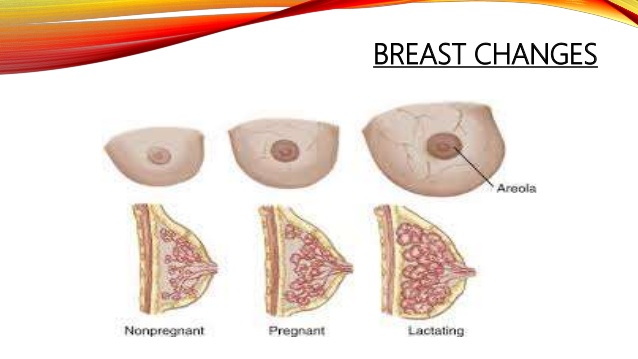
After conception, the level of the hormone of women changes rapidly. Because of these changes their breast becomes swollen sore.it occurs 1 or 2 weak later after conception. the area around the nipples called areola might darken. If these changes occur due to pregnancy it might take several weeks to get a new level of hormones. once a new level of hormones comes then there is ease up in the breast pain.
Fatigue

It is very normal to feel tired during pregnancy. if women feeling tired due to pregnancy so they must eat food that is rich in protein and iron.it can help to offset it. It is related to a high level of a hormone called progesterone also other things like lower levels of blood sugar, lower blood pressure, and a boost in blood production.
Nausea(morning sickness)

Nausea during pregnancy may occur at any time but mostly it seems that it occurs in the morning.it is a very famous or common sign of pregnancy but this is not necessary to get every pregnant woman. This is also related to hormonal changes because every woman does not eat proper food which is eaten by pregnant women for their health and also for their baby’s health.
Missed Period

The instant pregnancy test for women is missed period. It is the most evident sign of pregnancy but not every time it is not every time delayed due to pregnancy and also there are many more reasons for a missing period like you gained or lost too much weight, fatigue, and stress, or many more other possibilities. They missed a period when they stop taking birth control pills. But if the period is missing you should get to the pregnancy test.
Symptoms during pregnancy
Moodiness
This is also a common symptom during pregnancy because of the overflow of hormones in your body in early pregnancy that can make you unusually emotional and weepy.
Bloating
During early pregnancy there is hormonal changes occur that can cause you to feel bloated, similarly that you fell at the starting of your menstrual period.
Light spotting
When the fertilized egg attaches to the wall of the uterus about 10 to 14 days after conception and bleeding is occurs which is known as implantation bleeding. It takes place at the time of the menstrual period but it is not necessary for all women. sometimes it is the first sign of pregnancy.
Constipation
Constipation is an infrequent bowel movement, small, hard to pass, stool. and its examples are dehydration, lack of dietary fiber and physical inactivity, etc. it is also due to hormonal changes that cause the digestive system to slow down, which lead to constipation.
Nasal congestion
During pregnancy, there is an increase in hormone levels and blood production which is causing the mucous membrane in your nose to swell, dry out and bleed easily. This causes a runny nose.
Above there is some common sign and symptoms during pregnancy but there is much more significant and symptoms which are seen during pregnancy some of them are Heartburn, food aversion, diarrhea, vomiting, frequent urination, raised temperature, dizziness, headache and many more.
Some health tips that need to follow by pregnant women
Eating is most important during pregnancy, they should eat some healthy and nutritious food for their health and also for their good delivery experience.
During pregnancy, your body shape is rapidly changing so for a good experience you should wear tight clothes that can suffocate you and your body.
Pregnant women should have talked to their baby who cuddled in your womb. It should be good for your mental health and these are memorable and soul-soothing activities.
Pregnant women should necessarily exercise regularly because during pregnancy their body goes under several changes like shape and weight.
Drink more water to still dehydrated yourself drinking more water is beneficial for all but pregnant women should necessarily drink more water for their health
Signs of a Healthy Pregnancy
• Their Blood Sugar and Blood Pressure levels are normal
• Health of the Uterus and Placenta
• The development of the Foetus is normal
• weight gain of pregnant women
Pregnancy is one of the memorable periods for many women. In this time they should not take any stress only think about their baby and their health. For any type of query regarding their pregnancy, they should regularly contact their doctor.

Best 10 home remedies for curing dry cough
Cough is usually treated as an infection of a disease but it is like a necessary evil. It sometimes helps in removing the foreign materials or irritants from your throat. But cough can also occur due to the presence of infection in the throat too. Coughing continuously for a long time can be annoying. So the cure of the cough purely depends on the reason for its presence in the first place. Cough can be caused due to allergies, infections, and other factors too.
Cough can be cured by many allopathic medicines. But using herbs and home remedies can also cure cough without any chemical or medicinal interference in your body. So following are the 10 home remedies that can cure dry cough right at your home.
1.Honey tea
Since traditional times it has been said that honey is known to have many medicinal values as well as therapeutic effects on skin and others. Curing cough is one of the main therapeutic uses of honey. There was a study performed to test the therapeutic effect of honey on children. Many children with nighttime coughing were treated with dark honey and others were treated with a medicine called dextromethorphan. It was found out that dark honey provided more relief to the children than the medicine called dextromethorphan. Although there weren’t a large number of benefits that honey had over dextromethorphan, still it was preferred by most parents over the medicine. To safely consume this to cure cough, two spoons of honey were added to warm water or any herbal tea and consumed at least two times a day. This would effectively cure your cough. But honey is not advised to give children below one year of age.

2.Ginger
When we have a dry cough apart from the unpleasant feeling of coughing there is a lot of pain and discomfort that is felt usually by coughing constantly. Ginger is known to have anti-inflammatory properties which may provide you relief from the pain and discomfort. This may also provide you ease while coughing. Moreover, it is found that the anti-inflammatory substances present in ginger are known to dilate the respiratory tract so that it would ease up the cough. Till now the effects of ginger have just been seen in animals and human beings so more research is needed to be done.
To consume it right, you can add approx. 30g of ginger in a hot water and let it steep for a few minutes before you consume it. For further taste and comfort to your cough, you can also add lemon or honey to it.
But in some cases, ginger tea is known to cause heart urn and many digestive problems.

3.Fluids
Keeping yourself hydrated at this time is one of the main things you have to keep in mind. According to many studies it has been proved that drinking fluids at room temperature can stimulate the running nose and cough and sneezing. It is always advisable to warm up your fluids before consumption. Warming up of fluids can provide relief to your throat as well as can reduce the symptoms too.

4.Steam
Taking the steam can help you to cure mostly wet coughs and mucus and phlegm but in case of dry cough, this has been found effective. You can take a shower in hot water and let the team fill up the bathroom and you can stay in it till your symptoms are reduced. Afterward drinking some cool water or any fluid is encouraged to prevent your body from dehydrating

5.Marshmallow root
This is a herb that is used to reduce the pain and discomfort caused by coughing. It does it because it has mucilage in it. Mucilage is a thick coating that the marshmallow root lays on the throat. It is a sticky and thick content. It protects the throat from wearing due to the cough. In a study, the effectiveness of this marshmallow root was proven. The people suffering from cough were given cough syrup which had marshmallow root and thyme and ivy in it. After 10-12 days 90% of those people felt relieved and they did not have a cough anymore.

6.Saltwater gargle
It helps in reducing the phlegm in the throat and it, in turn, lessens the urge to cough. Half a teaspoon of salt is added to hot water. And this water is used to gargle so that it reduces the phlegm.

7.Bromelain
It is an enzyme. This enzyme is mostly found in pineapples. Bromelain contains anti-inflammatory properties and is used to treat mucolytic. This nature helps in reducing the phlegm and breaking it down and removing it out of your body. This is an enzyme so it is possible to be allergic to it. It can also interfere with medication and have side effects. Mainly for people who take blood thinners should steer clear of bromelain.

8.Probiotics
This does not directly act in preventing cold but it plays an important role in improving your immune system. If your immune system is strong your immunity will help in fighting all the allergens infections and all other causes of your cough. Out of all the probiotics, lactobacillus is one of the best probiotics that helps in preventing the common cold and cough, etc. Some medications are rich in this lactobacillus that is readily available in all drug stores but in the case of home remedies, you should consume dishes like kimchi, yogurt, miso soup, etc.

9.Dietary changes for acid reflux
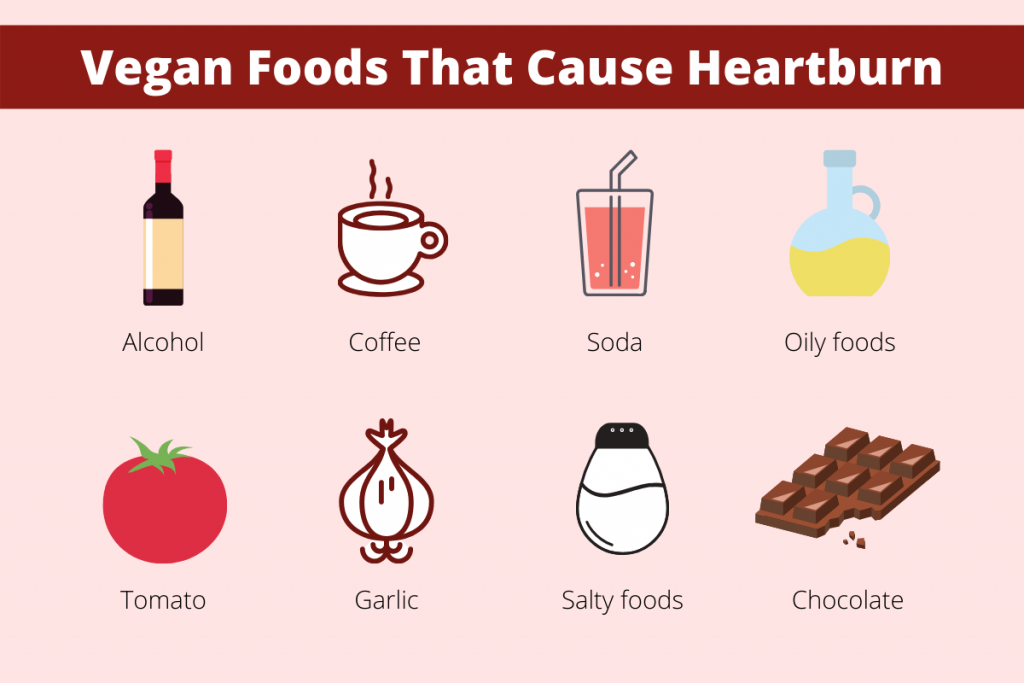
Acid reflux is one of the main causes of cough. You can easily reduce cough by reducing acid reflux. You can reduce acid reflux by stopping the intake of this kind of food which stimulates acid reflux. These kinds of foods are alcohol, chocolates, caffeine, onion and garlic, fried and fatty food.
10.Slippery Elm
This is a traditional method of north America. The people there traditionally used to consume the bark of this slippery elm tree to cure dry cough and common cold.


10 Most Common Skin Diseases & Skin Disorders
Skin is one of the most important parts of our body. They are the parts that get the most attention. We spend a fortune on maintaining our skin and preserving the glow in our skin. We need to know about the pathogens or the infections which may affect your skin. Because the infection and pathogens on our skin can not be corrected by skin products that are available online. Our skin is known as the largest organ in our body. It covers our muscles and nerves and protects them from injury or bacteria from the outside world. It extends from the tip of the skull to the tip of the toes. Skin diseases are known to be the most severe. They can be temporary, permanent, or they can be recurring.
Some are caused due to certain circumstances while most others are caused due to genetics. There are other skin infections caused due to trauma too. Most skin conditions are not a threat to life but other skin conditions are a threat to life. They can be chronic and lead to death. If you find any skin defects or any abnormalities in your skin, you should go to the doctor immediately. To be able to identify the skin conditions,
10 most common skin diseases are mentioned below.
1. Acne
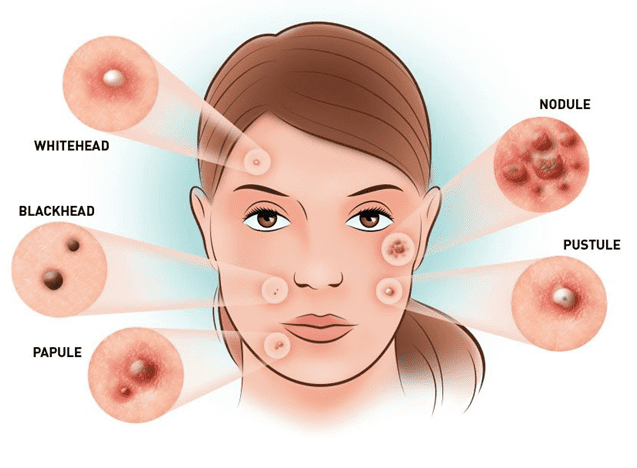
These are small red elevations on your skin that lead to a bad appearance of your skin. It usually occurs in your face and it can occur in groups or a single big and redone. These are mostly found in the areas of the face, neck, shoulders, chest, upper back, etc. It occurs on the skins with blackheads, Whitehead, pus, pimples, or they can also appear as cysts in the deeper tissue. They do not leave scars but if the acne is irritated then it might leave a scar on your skin.
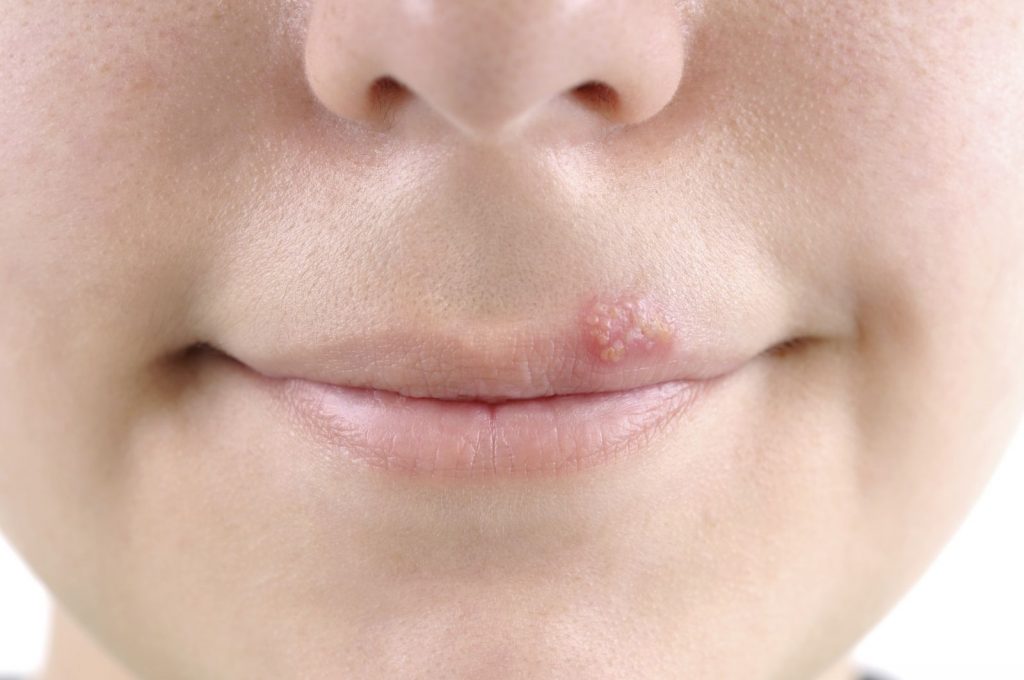
2. Cold sores
Cold sores are blister-like appearances that occur mostly on your face. The infections that occur on your face should be taken care of better than the infection in your upper body or the trunk. They occur mostly on your lips, the upper lips, and nose areas. You can know if you’re going to have it beforehand. The skin on which you will have it will tingle or you will feel a burning sensation before the scar is visible. These can also appear with flu-like features. Mostly the patient will have a low fever, headache, chill, swollen lymph nodes, and body aches.
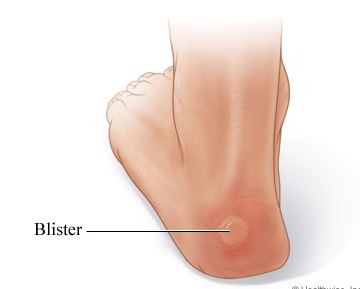
3. Blisters
This is a very common infection that occurs on the skin. It is very painful. Usually occurs due to trauma to the skin for a long time and it also causes a lot of pain and discomfort. It can be differentiated from other infections based on a clear, watery fluid-filled area on the skin. It is either smaller than 1 cm or it is larger than 1cm. The blisters which are smaller than one centimeter are called vesicles and the one’s larger area is known as bulla. They can occur in groups or they can occur singly. It can occur anywhere in our body and has no special preferences.
4. Hives
These are the patterns that are linked with allergy. It occurs only with the contact of an allergen. Mostly known as an allergy reaction of the skin when it comes in contact with an allergen. These are itchy raised patterns that mostly relish in color. So these are red warm to feel and painful when touched. Typically small round ring-shaped but at times they can be irregular and large.

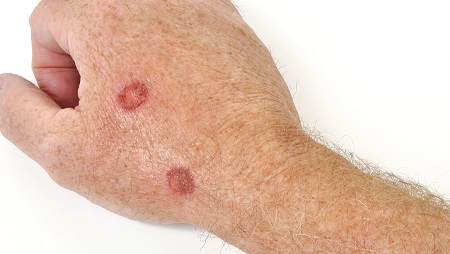
5. Actinic keratosis
It’s even less than 2 cm. They are sometimes the size of a pencil eraser. It has a thick scaly rough skin patch that has a crusty appearance. The site of occurrence in the body is that part that is mostly exposed to the sun. These are mostly hands, neck, face, arms, and scalp. These are usually pink in color. But it can have a gray-brown or tan base.
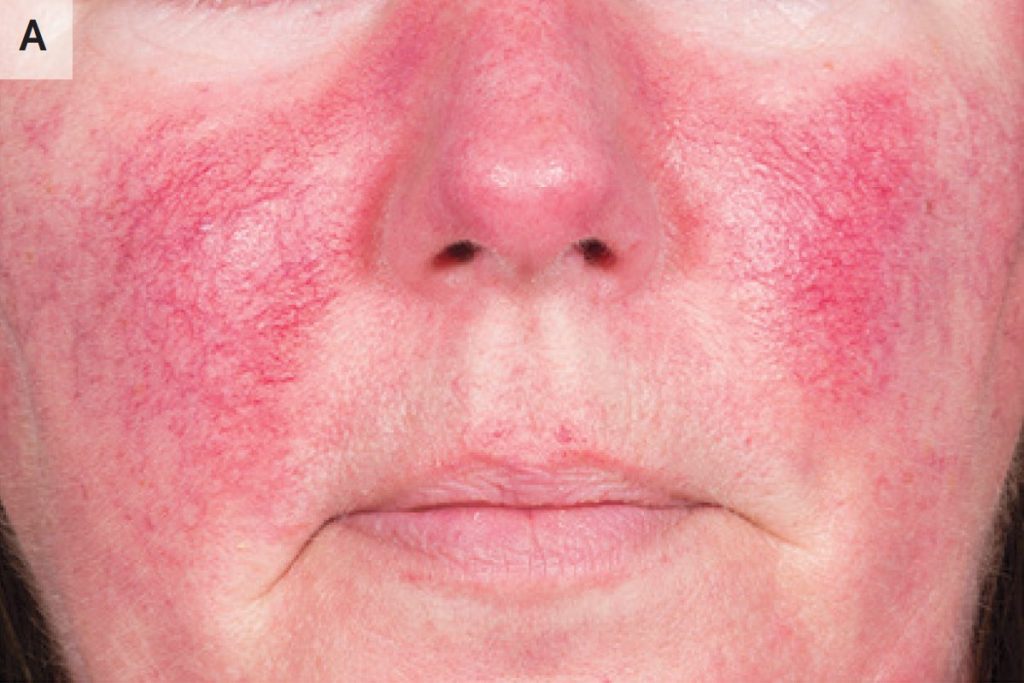
6. Rosacea
It is a chronic skin disease. Usually fades up and then reappears again. It cycles that way. The reappearing of this can depend on many physical conditions. Some of them are stress, alcohol consumption, intestinal bacteria like helicobacter pylori, or overexposure to sunlight. This disease has four different types of infection with a large variety of symptoms. The most common symptoms are facial redness, facial blushing, facial red bumps on the skin, skin dryness, skin sensitivity.
7. Carbuncle
It is a lump that is present under your skin, usually lor and sore to the touch, can feel irritated when it occurs. It may demonstrate many flu-like symptoms that are fever, chills, body aches, etc. So It can cause skin crustiness. It also causes ooziness.
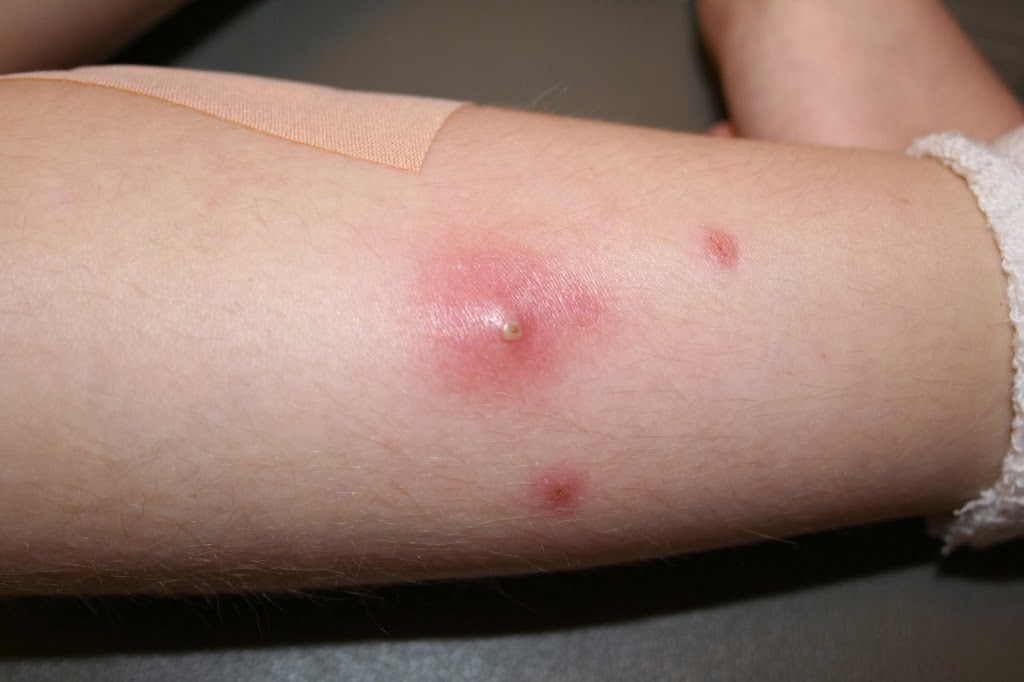
8. Latex allergy
It is another common skin condition caused by the use of latex mostly as a glove. It is a severe and emergency condition. Immediate doctor’s care should be needed If this happens. The rash can occur for minutes or can take days to appear. It appears when the skin is exposed to latex. It is characterized by the appearance of red spots and it may feel itchy. The site gets dry and feels crusty when the area is exposed to latex repeatedly. Apart from using If latex gloves, airborne latex can also cause cough, running nose, itchy, watery eyes, and many more symptoms. Severe allergy can cause swelling and difficulty in breathing. When it not cares well, it makes a skin diseases.
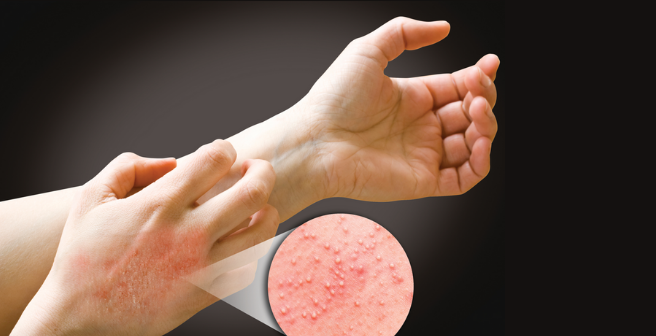
9. Eczema Skin Diseases
These are yellow and red patches that can have a flaky appearance. These are elevated areas and are sensitive to touch. Hair loss may occur in these areas. When it not treats well, it creates skin diseases.
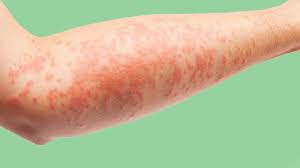
10. Vitiligo Skin Disease
It is a most common skin disorder in tropical countries. It occurs due to an autoimmune disorders. The body defense mechanism kills the cells of our own body. This gives skin its color.


How to Support a Loved One Through Mental Health Challenges: A Compassionate Guide
Understanding Your Role as a Supportive Presence
When someone you care about is facing mental health challenges, you may find yourself navigating unfamiliar emotional territory. You want to help, but you’re unsure where to begin. Perhaps you’ve noticed changes in their behavior, mood, or daily routines that concern you. Maybe they’ve opened up to you about their struggles, or perhaps you’re sensing something is wrong but haven’t yet had that conversation. Whatever your situation, knowing how to offer meaningful support can make a profound difference in their journey toward wellness.
Supporting a loved one through mental health difficulties isn’t about having all the answers or fixing their problems. It’s about showing up consistently, listening without judgment, and helping them access the resources they need. Your presence and compassion can serve as anchors during their most challenging moments, reminding them they’re not alone in this experience.
Recognizing the Signs That Someone Needs Support
Before you can offer effective support, it helps to recognize when someone might be struggling. Mental health challenges manifest differently in each person, but there are common patterns you might notice. Your loved one may withdraw from activities they once enjoyed, seem persistently sad or anxious, or experience significant changes in sleep or eating patterns. You might observe increased irritability, difficulty concentrating, or expressions of hopelessness about the future.
Physical symptoms often accompany mental health struggles as well. Unexplained aches and pains, fatigue that doesn’t improve with rest, or frequent illness can all signal underlying emotional distress. Some individuals may turn to substances as a way of coping with overwhelming feelings, while others might engage in risky behaviors that seem out of character.
It’s important to remember that these signs don’t always appear dramatically. Sometimes the changes are subtle—a gradual pulling away from social connections, a slight decline in self-care, or a persistent lack of energy that they explain away as being busy or tired. Trust your instincts when something feels off, and approach the situation with curiosity rather than alarm.
Creating a Safe Space for Honest Conversation
Once you’ve decided to reach out to your loved one, the way you initiate the conversation matters tremendously. Choose a private, comfortable setting where you won’t be interrupted or overheard. Timing is equally important—avoid bringing up sensitive topics when either of you is rushed, stressed, or distracted. Instead, find a moment when you can both be fully present.
Begin the conversation with genuine concern rather than criticism or judgment. You might say something like, “I’ve noticed you seem different lately, and I’m concerned about you. I’m here if you want to talk.” This approach opens the door without forcing them through it. Some people will immediately share what they’re experiencing, while others may need time to process before they’re ready to open up.
As they share their experiences, practice active listening. This means giving them your full attention, maintaining appropriate eye contact, and resisting the urge to interrupt with solutions or your own stories. Validate their feelings by acknowledging the difficulty of what they’re going through. Phrases like “That sounds really challenging” or “I can see how much this is affecting you” communicate that you hear and accept their reality without minimizing their pain.
Avoid common pitfalls like telling them to “just think positively” or suggesting that others have it worse. These well-meaning comments can actually make someone feel more isolated and misunderstood. Similarly, resist the temptation to take their struggles personally or make the conversation about your own discomfort with their situation.
Practical Ways to Offer Day-to-Day Support
Supporting someone with mental health challenges extends beyond a single conversation. Your ongoing presence and practical assistance can provide stability during their most difficult days. The key is offering specific, tangible help rather than vague promises to “be there if they need anything.”
Consider the daily tasks that might feel overwhelming to someone struggling with their mental health. Preparing meals, running errands, or handling household chores can become monumental challenges when someone is dealing with depression, anxiety, or other conditions. Instead of asking what they need, which can feel like another burden, offer concrete assistance: “I’m going to the grocery store this afternoon. Can I pick up anything for you?” or “I’d like to drop off dinner on Tuesday. Would that be helpful?”
Regular check-ins demonstrate your continued care and commitment. A simple text message saying you’re thinking of them, a phone call to say hello, or an invitation for a low-pressure activity like a walk can remind them they’re valued and remembered. However, respect their boundaries if they need space. Some days they may welcome company, while other times they may need solitude to process their emotions or simply rest.
Encourage self-care practices without being pushy. You might invite them to join you for activities that support mental wellness, such as gentle exercise, time in nature, or creative pursuits. If they’re not up for going out, you could bring these activities to them—perhaps by watching a favorite movie together at their home or working on a simple craft project side by side.
Understanding Professional Support Options
While your support is valuable, professional help is often essential for addressing mental health challenges effectively. Understanding the landscape of available services can help you guide your loved one toward appropriate resources. Mental health care encompasses a wide range of professionals and approaches, from traditional therapy and psychiatry to more specialized support services.
Therapists and counselors provide a confidential space where individuals can explore their thoughts, feelings, and behaviors with a trained professional. Different therapeutic approaches work better for different people and situations—cognitive behavioral therapy, dialectical behavior therapy, trauma-focused therapy, and many other modalities offer distinct frameworks for healing and growth.
Psychiatrists can evaluate whether medication might be beneficial as part of a comprehensive treatment plan. Many mental health conditions respond well to a combination of therapy and medication, though the right approach varies for each individual. It’s worth noting that finding the right medication and dosage often requires patience and ongoing communication with healthcare providers.
For those seeking more intensive or personalized support, specialized services can provide tailored assistance that adapts to individual needs and lifestyles. Organizations like next level recovery associates offer comprehensive behavioral health support that meets people where they are, providing everything from ongoing companionship and case management to specialized interventions and care coordination. These concierge-style services can be particularly valuable for individuals who need flexible, discreet support that integrates seamlessly into their daily lives.
Support groups provide another valuable resource, connecting individuals with others who understand their experiences firsthand. Whether in-person or online, these communities offer validation, practical advice, and the comfort of knowing you’re not alone in your struggles. Many groups focus on specific conditions or situations, allowing participants to connect with others facing similar challenges.
Navigating Resistance to Getting Help
One of the most challenging aspects of supporting someone with mental health difficulties is encountering their resistance to seeking professional help. This resistance can stem from many sources—fear of judgment, concerns about cost or time commitment, skepticism about whether treatment will help, or simply feeling too overwhelmed to take the first step.
When your loved one resists help, avoid pushing too hard or issuing ultimatums, which often backfire by increasing defensiveness. Instead, try to understand the specific barriers they’re facing. Are they worried about confidentiality? Do they have concerns about how treatment might affect their work or relationships? Are they uncertain about where to start or how to find a good provider?
Address their concerns with accurate information and reassurance. Explain that mental health treatment is confidential, protected by strict privacy laws. If cost is a concern, research affordable options together, including sliding-scale therapists, community mental health centers, or insurance coverage they may not realize they have. If they’re worried about time commitment, help them understand that many providers offer flexible scheduling, including evening and weekend appointments or virtual sessions.
Sometimes people resist help because they don’t believe they “deserve” it or their problems are “serious enough.” Gently challenge these beliefs by reminding them that everyone deserves support, and seeking help is a sign of strength, not weakness. You might share that mental health care isn’t just for crisis situations—it’s also valuable for personal growth, stress management, and developing healthier coping strategies.
If your loved one continues to resist professional help, focus on what they are willing to do. Perhaps they’re not ready for therapy but would consider reading self-help books, trying meditation apps, or attending a support group. Small steps forward are still progress, and sometimes these initial actions build confidence and openness to more comprehensive support later.
Taking Care of Yourself While Supporting Others
Supporting someone through mental health challenges can be emotionally and physically draining. You may experience what’s known as compassion fatigue—a state of emotional exhaustion that occurs when you’re constantly absorbing another person’s pain and stress. Recognizing this possibility and prioritizing your own well-being isn’t selfish; it’s essential for sustaining your ability to be present for your loved one.
Set healthy boundaries around your time and energy. You can be supportive without being available every moment of every day. It’s okay to say, “I need to take care of some things today, but I’ll check in with you tomorrow,” or “I’m not in a good headspace to talk about this right now, but let’s find a time later this week.” These boundaries protect both of you—they prevent your resentment from building and model healthy self-care for your loved one.
Maintain your own support system and self-care practices. Continue engaging in activities that replenish you, whether that’s exercise, creative hobbies, time with other friends and family, or simply quiet moments alone. Don’t let your entire life revolve around your loved one’s struggles, no matter how much you care about them.
Consider seeking your own support, whether through therapy, support groups for family members and friends of people with mental health conditions, or simply talking with trusted individuals in your life. Carrying the weight of someone else’s struggles without your own outlet can lead to burnout, anxiety, or depression.
Remember that you’re not responsible for fixing your loved one or for their choices. You can offer support, resources, and encouragement, but ultimately they must be the ones to engage in their own healing process. Accepting this reality can relieve some of the pressure you might feel to make everything better.
Recognizing When More Intensive Intervention Is Needed
Sometimes mental health challenges escalate to a point where standard support isn’t sufficient. Knowing when to seek more intensive intervention can literally save someone’s life. If your loved one expresses thoughts of self-harm or suicide, has a specific plan to hurt themselves, or begins giving away cherished possessions or saying goodbye in ways that feel final, immediate action is necessary.
In crisis situations, don’t leave the person alone. Contact emergency services, take them to the nearest emergency room, or call a crisis hotline for guidance. The 988 Suicide and Crisis Lifeline provides 24/7 support and can help you determine the appropriate next steps. While these situations are frightening, remember that crisis intervention services exist specifically to handle these moments and can provide the immediate safety and stabilization your loved one needs.
Less acute but still serious situations might warrant consideration of more intensive treatment options, such as partial hospitalization programs, intensive outpatient programs, or residential treatment. These structured environments provide comprehensive support while allowing individuals to develop coping skills and establish stability. Having honest conversations with mental health professionals can help you understand whether these levels of care might benefit your loved one.
Celebrating Progress and Managing Setbacks
Recovery from mental health challenges is rarely linear. Your loved one will likely experience both progress and setbacks along their journey. Understanding this reality helps you maintain realistic expectations and provide appropriate support through all phases of their experience.
Celebrate the victories, no matter how small they might seem. Getting out of bed on a difficult day, attending a therapy appointment, or reaching out for support when struggling—these are all significant accomplishments that deserve recognition. Your acknowledgment of their efforts can provide motivation and reinforce positive steps forward.
When setbacks occur, respond with compassion rather than disappointment. Remind your loved one that healing isn’t about perfection; it’s about continuing to move forward even after stumbling. Help them reflect on what they’ve learned from the setback and what might help them navigate similar situations differently in the future. Your steady presence during difficult moments communicates that your support isn’t conditional on their constant progress.
Encourage patience with the process. Mental health healing takes time, and there’s no predetermined timeline for feeling better. Some days will be harder than others, and that’s a normal part of the journey. Your role is to remain a consistent, supportive presence regardless of where they are in their process.
Building a Sustainable Support Network
While your individual support is valuable, your loved one will benefit most from a network of support rather than relying solely on one person. Help them identify and connect with multiple sources of support, creating a web of care that can sustain them through various challenges and circumstances.
This network might include other family members and friends, professional providers, support groups, faith communities, or workplace resources like employee assistance programs. Each connection serves a different purpose and provides different types of support, creating a more robust safety net than any single relationship can offer.
Encourage your loved one to communicate their needs to different people in their network. Some individuals might be better suited for practical help, while others excel at emotional support. Some might be available for crisis moments, while others provide steady, ongoing presence. Helping them think strategically about who to reach out to in different situations empowers them to advocate for their own needs.
Remember that building this network takes time and effort. You can facilitate connections by introducing your loved one to resources or other supportive individuals, but ultimately they need to develop these relationships themselves. Your role is to encourage and enable these connections, not to manage them.
Moving Forward Together
Supporting a loved one through mental health challenges is one of the most meaningful contributions you can make to another person’s life. Your willingness to show up, listen without judgment, and walk alongside them during difficult times provides hope and stability when they may feel lost or alone. While the journey may be long and sometimes difficult, remember that your presence makes a difference even when progress feels slow or invisible.
Stay informed about mental health, continue developing your own capacity for compassionate support, and remain open to learning from your loved one about what helps them most. Every person’s experience is unique, and the most effective support often comes from asking what they need rather than assuming you know best.
Above all, hold onto hope—for your loved one, for yourself, and for the possibility of healing and growth. Mental health challenges are real and significant, but they’re also treatable. With appropriate support, professional help, and time, many people not only recover but discover new strengths and insights through their experiences. Your role in that journey, however large or small it may feel, contributes to creating a world where people facing mental health challenges know they’re valued, supported, and never truly alone.

General Audience: Key Considerations When Looking for Gonadorelin 5mg for Sale
Searching for Gonadorelin 5mg for sale can often lead individuals through a labyrinth of choices, each with unique considerations. Gareth Jones, a pharmaceutical researcher noted, “The market for peptides like Gonadorelin can be complex, with variations in quality, price, and legality.”
Understanding these nuances is vital for making an informed decision that aligns with one’s health needs and legal boundaries. Below, we explore key aspects every buyer should evaluate before purchasing Gonadorelin 5mg.
Navigating the Market for Gonadorelin 5mg: Key Factors to Consider

When considering the purchase of Gonadorelin 5mg, the concentration of the peptide solution is of paramount importance. Different suppliers may offer it in various concentrations, which can affect both the price and the dosage required for effective use.
Moreover, Gonadorelin’s stability under different storage conditions is another critical aspect. A representative from the International Peptide Society stated, “Peptides like Gonadorelin require precise storage to maintain their efficacy, which not all suppliers can guarantee.”
gonadorelin 5mg for sale Therefore, buyers should inquire about the stability data and recommended storage practices from the supplier, ensuring that the product remains effective over time. This level of diligence is crucial for anyone looking to implement Gonadorelin into their regimen.
Assessing the Quality and Purity of Gonadorelin 5mg Products
The quality and purity of Gonadorelin are perhaps the most critical elements determining its efficacy and safety. The presence of impurities can significantly impact the expected physiological response and may lead to unintended side effects.
All reputable suppliers should offer a Certificate of Analysis (CoA) as a transparency measure, detailing the purity levels and the presence of contaminants. According to a recent survey, 84% of peptide users consider a CoA to be a non-negotiable factor when purchasing peptides.
Prospective buyers are advised to seek out vendors who utilize third-party lab testing for their products. This practice ensures an unbiased confirmation of the Gonadorelin’s quality. Independent lab verification can provide the peace of mind that the purchased peptide meets the claimed standards.
Legal and Safety Aspects of Purchasing Gonadorelin 5mg
Purchasing Gonadorelin 5mg is subject to varying legal considerations depending on geographic location and intended use. It’s paramount to verify that Gonadorelin is legal to buy and use in your region, as regulatory frameworks differ worldwide.
Another aspect to consider is the intended use of the peptide, which could be research, therapeutic or other applications. A compliance officer comments, “Understanding the legal implications of Gonadorelin’s intended use can preempt legal complications.” This knowledge can protect the buyer from unintentional legal infringements.
Familiarize yourself with the regulatory guidelines and standards applicable to Gonadorelin to ensure that all legal and safety requirements are met. Purchasing from suppliers who are open about their compliance with regulations can also help avoid potential legal issues.
Identifying Reliable Suppliers for Gonadorelin 5mg Online

Finding a trustworthy supplier for Gonadorelin 5mg online hinges on several factors, including transparency, customer reviews, and industry reputation. Transparency, in particular, is a telltale sign of reliability; look for suppliers that provide exhaustive product details and customer service.
Customer reviews and testimonials offer an unfiltered glimpse into others’ experiences with a supplier. A study from the Consumer Trust Index indicates that 76% of consumers trust online reviews as much as personal recommendations—a vital statistic in gauging vendor reliability.
Evaluating a supplier’s reputation within the industry and presence in professional networks can provide further assurance of their legitimacy. Engaging with community forums and speaking with industry insiders can give additional insights into the best sources for Gonadorelin 5mg.
Ultimately, selecting the right supplier of Gonadorelin 5mg involves careful consideration of quality, legality, and reputability. By researching thoroughly and demanding transparency, you can make an educated choice that prioritizes both effectiveness and adherence to safety regulations.

Why most mental health clinics fail within 5 years — and the operational gaps nobody talks about
Key takeaways
- Prior authorization reform is now live: under CMS-0057-F, payers must issue urgent decisions within 72 hours and standard decisions within 7 calendar days — but faster responses only benefit clinics whose submissions are already clean.
- Becker’s Behavioral Health documented 18 behavioral health closures in 2025 and a further wave in 2026. The stated causes are consistently financial and administrative, not clinical.
- According to a KFF consumer survey, one in five insured adults who used mental health services reported a denied claim — the same rate as emergency room visits, and substantially above most other care types.
- As of December 2025, 40% of the US population — approximately 137 million people — lives in a Mental Health Professional Shortage Area (HRSA). Clinics that close in those communities are not easily replaced.
- CMS-0057-F Phase 2, requiring FHIR-based Prior Authorization APIs, takes effect January 2027. Whether a clinic’s EHR supports that integration is an operational question that needs an answer now.
The reform that changes the equation
On 1 January 2026, the first operational phase of CMS-0057-F — the CMS Interoperability and Prior Authorization Final Rule — came into effect. According to CMS, covered payers must now issue urgent prior authorizations decisions within 72 hours and standard decisions within 7 calendar days, replacing timelines that commonly ran 14 to 30 days. A second phase requiring FHIR-based Prior Authorization APIs takes effect 1 January 2027.
The reform is real. The relief is not automatic.
A clinic still running disconnected billing systems, manual authorizations workflows, and documentation not structured for payer review will not benefit from faster timelines. It will receive faster denials. The four operational gaps that quietly erode behavioral health clinics — in revenue cycle management, care coordination, documentation, and compliance readiness — were survivable when a prior auth decision took three weeks. They are not, when it takes seven days.
What the closure data actually shows
Becker’s Behavioral Health documented 18 behavioral health closures in 2025 and a further wave in 2026. The stated reasons — financial losses tied to Medicaid billing failures, reimbursement rate cuts, inability to sustain operations — are consistently operational, not clinical. Philadelphia-based Wedge Recovery Centers, which operated seven clinics, closed after three years of financial losses attributable to declining Medicaid enrollment and rising overhead costs. Laurel Ridge Treatment Center in San Antonio lost its Medicare provider agreement after CMS cited failure to comply with health and safety participation requirements, triggering layoffs of approximately 648 employees.
The pattern is consistent. Behavioral health clinic failures are almost never clinical failures. They are systems failures.
According to HRSA’s December 2025 State of the Behavioral Health Workforce report, 40% of the US population, approximately 137 million people, live in a Mental Health Professional Shortage Area. The clinics that close in those communities are not easily replaced.
Gap 1: Billing infrastructure that was not designed for behavioral health
Behavioral health billing operates under a distinct set of rules. Every individual session must independently establish medical necessity unlike most medical specialties, where a diagnosis drives a treatment plan and visit-level documentation faces less scrutiny. Time-based CPT codes such as 90832, 90834, and 90837 are among the most frequently audited in the entire claims ecosystem.
A KFF consumer survey found that one in five insured adults who used mental health services reported a denied claim. An analysis of commercial plan data cited by the American Association of Medical Colleges found that one in five medically necessary behavioral health claims were denied in 2020. The Journal of AHIMA puts the administrative cost to rework a denied claim at $25 for physician practices and up to $181 for hospitals — and a significant share of denials are never resubmitted at all, representing permanent revenue loss.
The clinics most exposed to this gap are those using general-purpose medical billing systems retrofitted with behavioral health fields. The manual workarounds those systems require such as tracking payer-specific authorizations rules outside the platform, managing modifier requirements separately etc. create the coding inconsistencies that produce denials in the first place.
Gap 2: Care coordination that lives outside the clinical record
When care coordination activity runs through spreadsheets, email threads, or staff memory rather than through the clinical record, two things happen simultaneously: outcomes suffer and the documentation that justifies ongoing treatment becomes impossible to produce at the point of need.
Payers reviewing prior authorizations requests are not simply checking whether a service was delivered. They are reviewing whether the clinical rationale — the connection between the intake assessment, the treatment plan, and the current progress note — is legible within the record itself. In multi-provider settings, when a prescriber, therapist, and care coordinator are each documenting in separate systems, that integrated picture cannot be assembled quickly.
What genuinely integrated care coordination looks like in practice — and what it costs when the gaps stay open — is examined in detail in Closing the gaps: how integrated care coordination saves time, money and lives.
Gap 3: Documentation workflows that create payer exposure
Documentation burden is a workforce problem and a compliance problem, and in 2026 they are the same problem. HRSA’s December 2025 State of the Behavioral Health Workforce report identifies reimbursement challenges and clinician burnout as the key provider-level barriers preventing behavioral health clinicians from performing at full capacity. When documentation is slow and structurally incomplete, clinicians spend uncompensated time completing notes after hours — notes more likely to be flagged for missing functional impairment data or measurable progress markers.
Payers are now deploying AI-driven claims analysis to identify notes that lack those specific elements. A progress note missing a functional status update can trigger retroactive denial across multiple sessions. The issue is not note length. It is note structure.
What high-performing clinics do differently is build documentation templates around what payers actually require, not clinical preference alone. Platforms purpose-built for behavioral health, such as integrated care management systems like blueBriX’s behavioral health EHR, are designed to connect clinical documentation, billing, and care coordination in one workflow. That integration is what makes audit-ready notes a standard output rather than a reactive response to a denial.
Gap 4: Compliance infrastructure that responds to policy, not audits
The regulatory environment in 2026 is not stable. The Trump administration announced in May 2025 it would not enforce the strengthened 2024 MHPAEA parity regulations, while regulators simultaneously signaled more aggressive parity audits around non-quantitative treatment limitations — prior authorization criteria, network adequacy, and medical necessity standards. Updated 42 CFR Part 2 rules governing substance use disorder records took full effect February 16, 2026, adding documentation obligations many clinics are still absorbing.
Clinics whose compliance posture is reactive — adjusting workflows after a denial, updating documentation standards after an audit — will consistently be operating behind this curve. A systematic review published in The American Journal of Medicine (Johns Hopkins Medicine, September 2025) found that across 11 behavioral health studies, prior authorization delays are linked to treatment interruptions, higher relapse rates, and worse outcomes for patients with psychiatric illness or substance use disorder. The clinical consequences of compliance failure reach patients before they appear in revenue reports.

What high-performing clinics do differently
The clinics navigating 2026 successfully share a recognizable pattern. Billing tools are designed for behavioral health coding requirements, not adapted from general medicine. Care coordination is visible within the clinical record. Documentation workflows are built around payer review criteria. Compliance infrastructure is maintained by the technology layer, not by manual staff effort.
The common failure is treating each gap as a separate problem requiring a separate tool. The operational fragmentation that results — billing in one system, documentation in another, coordination in a third — is itself what makes the other four gaps permanent.
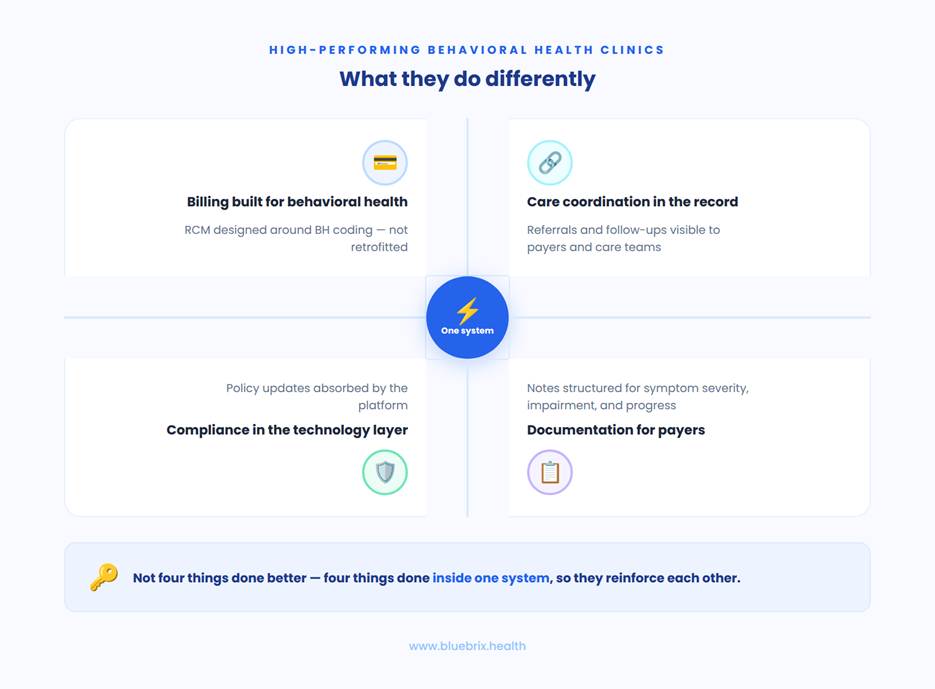
Behavioral health clinic closures are rarely caused by poor care. They are caused by excellent clinical programs built on operational infrastructure that was never designed to sustain them financially. CMS-0057-F’s 2026 deadlines did not create that problem. They removed the buffer that allowed it to persist.
The bottom line
Behind every operational gap is a patient who did not get the care they needed — because a prior auth was delayed, a claim was denied, or a clinic could no longer afford to stay open. The four gaps in this article are fixable. They require deliberate investment in the right infrastructure, not heroic effort from already stretched clinical teams. Getting the operations right is not a business decision separate from the mission. In behavioral health, it is the mission. Recognising which of the four gaps is costing the most is the starting point. Acting on it, with systems designed specifically for behavioral health rather than adapted from general medicine, is what separates the clinics still operating in five years from those that are not.
Frequently asked questions
What does CMS-0057-F require from behavioral health providers in 2026?
The January 2026 phase places obligations on payers, not directly on providers. According to CMS, covered payers must now issue urgent prior authorizations decisions within 72 hours and standard decisions within 7 calendar days, and must give specific denial reasons. The practical implication for providers is that incomplete submissions no longer have weeks to be corrected — documentation must be complete at the point of submission.
Why are behavioral health clinics closing if demand for services is rising?
Rising demand does not protect a clinic with operational gaps. Becker’s Behavioral Health reporting shows closures in 2025 and 2026 are consistently tied to financial and administrative causes — Medicaid billing failures, overhead costs, reimbursement shortfalls — rather than low patient volume. Demand and financial viability are separate variables in behavioral health.
What is the FHIR prior authorizations API requirement and when does it affect providers?
CMS-0057-F Phase 2, effective January 2027, requires covered payers to implement FHIR-based Prior Authorization APIs conforming to the HL7 Da Vinci standard. When operational, providers using a compatible EHR will be able to submit prior authorizations requests directly from their clinical workflow. The question for providers now is whether their EHR will support this integration before the deadline.
How does documentation structure affect prior authorizations outcomes?
In behavioral health, every session must independently establish medical necessity. Payers and their AI-driven review systems are checking for measurable symptom severity, functional impairment data, and documented progress toward treatment goals. A note that is clinically accurate but structurally incomplete is treated as an undocumented service. Note structure — not just content — is a direct revenue variable.
Author Bio

Shahzad Mohammad
Chief Product Officer
Shahzad Mohammad is Co-founder and Chief Product Officer at blueBriX, where he has played a central role in shaping the platform from day one. He helped turn a vision for accessible, customizable digital health tools into reality. Passionate about reducing complexity and empowering care teams, Shahzad focuses on building technology that improves patient outcomes and accelerates healthcare innovation.
LinkedIn Profile: https://www.linkedin.com/in/shahzad-mohammad-7646b014/

Understanding the Connection Between Mental Health and Physical Wellness in Recovery
The Inseparable Bond Between Mind and Body
When you’re working toward recovery from substance use challenges, you might find yourself focusing primarily on stopping the behavior itself. However, your journey involves far more than abstinence alone. Your mental health and physical wellness are deeply interconnected, each influencing the other in ways that can either support or hinder your progress. Understanding this connection gives you powerful insight into creating a sustainable path forward.
Your brain and body communicate constantly through complex networks of neurotransmitters, hormones, and nervous system signals. When substance use disrupts these systems, the effects ripple through every aspect of your health. Depression might manifest as chronic fatigue. Anxiety can trigger digestive problems. Trauma stored in your body might emerge as muscle tension or pain. Recognizing these connections helps you address the whole picture rather than isolated symptoms.
The relationship works both ways. Physical health problems can intensify mental health challenges, creating cycles that feel impossible to break. Poor sleep worsens depression. Chronic pain increases anxiety. Nutritional deficiencies affect mood regulation. When you address both dimensions simultaneously, you create synergistic healing that accelerates your recovery journey.
How Substance Use Affects Your Whole System
Substance use doesn’t exist in isolation within your body. It fundamentally alters your brain chemistry, affecting neurotransmitters like dopamine, serotonin, and GABA that regulate mood, motivation, and stress response. Over time, your brain adapts to these substances, requiring them to feel normal. This neurological adaptation explains why stopping feels so difficult—your brain has literally rewired itself around the substance.
Beyond brain chemistry, substances impact nearly every organ system. Your liver works overtime to process toxins, potentially leading to damage. Your cardiovascular system experiences stress through elevated heart rate and blood pressure. Your immune system becomes compromised, making you more susceptible to illness. Your digestive system struggles to absorb nutrients properly, leading to deficiencies that affect energy, mood, and cognitive function.
The physical toll extends to your sleep architecture. Substances disrupt natural sleep cycles, preventing you from reaching restorative deep sleep stages. Even when you sleep for hours, you wake feeling exhausted because your body hasn’t completed essential repair processes. This sleep deprivation then exacerbates mental health symptoms, creating another reinforcing cycle.
Your endocrine system also suffers significant disruption. Hormones that regulate stress, metabolism, and reproductive function become imbalanced. Cortisol levels may remain chronically elevated, keeping your body in a constant state of stress response. This hormonal chaos contributes to mood swings, weight changes, and difficulty managing emotions.
Common Co-Occurring Mental Health Conditions
If you’re navigating substance use challenges, there’s a strong likelihood you’re also managing mental health conditions. Research consistently shows that the majority of individuals with substance use disorders also experience conditions like depression, anxiety, PTSD, bipolar disorder, ADHD, or OCD. This isn’t coincidental—these conditions often share underlying causes and risk factors.
Depression and substance use frequently occur together, each worsening the other. You might have initially used substances to numb emotional pain or create temporary relief from persistent sadness. Over time, the substances themselves alter brain chemistry in ways that deepen depression. The guilt and shame surrounding substance use add another layer of depressive symptoms. Breaking free requires addressing both the substance use and the underlying depression simultaneously.
Anxiety disorders commonly co-occur with substance use as well. You might have discovered that certain substances temporarily quiet racing thoughts or reduce physical anxiety symptoms. However, as substances wear off, anxiety typically rebounds with greater intensity. Your body develops tolerance, requiring increasing amounts to achieve the same calming effect. Eventually, the substances that once provided relief become a primary source of anxiety themselves.
Trauma plays a particularly significant role in this connection. If you’ve experienced trauma—whether childhood adversity, violence, accidents, or other distressing events—you carry that experience in both your mind and body. Substances often serve as a way to manage trauma symptoms like hypervigilance, flashbacks, and emotional numbness. Effective recovery requires trauma-informed approaches that help you process these experiences safely while building healthier coping mechanisms.
For individuals with ADHD, substances might have initially helped with focus or impulse control. The stimulation or sedation provided temporary relief from ADHD symptoms. Similarly, those with bipolar disorder might have used substances to manage mood swings, either dampening manic energy or lifting depressive episodes. Recognizing these patterns helps you understand your substance use as an attempted solution rather than simply a problem.
The Role of Integrated Treatment Approaches
Traditional approaches often treated substance use and mental health conditions separately, requiring you to navigate different providers, conflicting advice, and fragmented care. Modern understanding recognizes that integrated treatment—addressing both dimensions simultaneously—produces significantly better outcomes. When you receive coordinated care that treats your whole experience, recovery becomes more achievable and sustainable.
Integrated treatment recognizes that you can’t successfully address substance use while ignoring underlying mental health conditions. Attempting to stop substance use without treating depression leaves you vulnerable to relapse when depressive symptoms intensify. Similarly, managing anxiety without addressing substance use means continuing behaviors that ultimately worsen anxiety. Comprehensive programs like those offered at Healing Rock Recovery provide coordinated care that addresses both substance use and mental health conditions through evidence-based therapies and holistic approaches tailored to your unique needs.
Evidence-based therapies form the foundation of effective integrated treatment. Cognitive Behavioral Therapy (CBT) helps you identify and change thought patterns that contribute to both substance use and mental health symptoms. You learn to recognize triggers, challenge distorted thinking, and develop healthier responses to difficult emotions. Dialectical Behavior Therapy (DBT) teaches skills for emotional regulation, distress tolerance, interpersonal effectiveness, and mindfulness—all crucial for managing co-occurring conditions.
Medication-assisted treatment often plays a valuable role in integrated care. Medications can help stabilize brain chemistry, reduce cravings, manage withdrawal symptoms, and treat underlying mental health conditions. When prescribed and monitored by knowledgeable professionals, these medications provide crucial support during early recovery when your brain is healing and rebalancing. They’re not substituting one substance for another—they’re providing medical support for legitimate health conditions.
Physical Wellness as a Recovery Foundation
Your physical health provides the foundation upon which mental health and recovery rest. When your body is malnourished, sleep-deprived, and sedentary, maintaining emotional stability becomes exponentially harder. Conversely, when you prioritize physical wellness, you create conditions that support mental clarity, emotional regulation, and resilience.
Nutrition deserves particular attention during recovery. Substance use often leads to poor eating habits—skipped meals, reliance on processed foods, or simply forgetting to eat. Your body may be depleted of essential vitamins and minerals that affect brain function and mood. B vitamins, omega-3 fatty acids, magnesium, and amino acids all play crucial roles in neurotransmitter production and mental health. Restoring proper nutrition isn’t about rigid dieting—it’s about nourishing your body with foods that support healing.
Regular physical activity offers profound benefits for both mental health and recovery. Exercise stimulates production of endorphins and other neurotransmitters that naturally improve mood. It reduces stress hormones, improves sleep quality, and builds confidence through achievement. You don’t need intense workouts—even moderate activities like walking, yoga, or swimming provide significant benefits. The key is consistency and finding activities you genuinely enjoy rather than viewing exercise as punishment or obligation.
Sleep restoration represents another critical component of physical wellness in recovery. Your body needs quality sleep to repair damage, consolidate learning, regulate emotions, and restore energy. Establishing healthy sleep habits—consistent bedtime routines, dark and cool sleeping environments, limiting screen time before bed—helps your body reestablish natural rhythms. Initially, sleep may remain difficult as your brain adjusts to functioning without substances. Patience and consistency eventually lead to improved sleep quality.
The Power of Holistic and Creative Approaches
While evidence-based therapies and medical interventions form essential components of recovery, holistic and creative approaches address dimensions that traditional methods sometimes miss. These approaches recognize that healing involves more than symptom reduction—it involves reconnecting with yourself, discovering new forms of expression, and finding meaning beyond substance use.
Creative therapies like art and music provide non-verbal outlets for processing emotions and experiences. You might struggle to articulate trauma or complex feelings in words, but expressing them through painting, drawing, or music can access deeper layers of experience. These creative processes activate different brain regions, facilitating healing through alternative pathways. They also help you discover new sources of joy and accomplishment that substance use had overshadowed.
Mindfulness practices teach you to observe thoughts and emotions without judgment or reactivity. Through meditation, breathing exercises, or body awareness practices, you develop the capacity to sit with discomfort rather than immediately reaching for substances to escape it. This skill proves invaluable throughout recovery as you encounter triggers, cravings, and difficult emotions. Mindfulness isn’t about eliminating these experiences—it’s about changing your relationship with them.
Nature connection offers profound healing benefits that complement clinical interventions. Time spent in natural environments reduces stress hormones, lowers blood pressure, improves mood, and enhances overall wellbeing. Whether hiking, gardening, or simply sitting outdoors, nature provides perspective, peace, and reminder that you’re part of something larger than your struggles. The natural world operates in cycles of growth, dormancy, and renewal—a powerful metaphor for your own recovery journey.
Cultural Considerations in Healing
Your cultural background, beliefs, and values shape how you understand health, illness, and recovery. Effective treatment honors these cultural dimensions rather than imposing a one-size-fits-all approach. For many individuals, particularly those from Indigenous communities, culturally grounded healing practices provide essential connections to identity, community, and traditional wisdom.
Indigenous approaches to healing often emphasize balance, connection to community and land, spiritual wellness, and intergenerational healing. These perspectives recognize that substance use and mental health challenges don’t exist solely within individuals—they reflect broader historical trauma, cultural disruption, and loss of traditional ways. Healing therefore involves reconnecting with cultural identity, participating in traditional practices, and understanding personal struggles within larger historical context.
Programs that incorporate culturally specific approaches acknowledge that healing looks different across communities. What works for one person may not resonate with another based on cultural background and beliefs. Culturally competent care means providers understand these differences, respect diverse healing traditions, and integrate them appropriately into treatment plans. This respect for cultural diversity creates space for you to heal in ways that align with your values and identity.
Building Your Support Network
Recovery doesn’t happen in isolation. The relationships and support systems surrounding you significantly influence your success. Building a strong support network involves identifying people who genuinely support your recovery, establishing healthy boundaries with those who don’t, and connecting with others who understand your experience.
Family involvement can be incredibly powerful when approached thoughtfully. Your substance use and mental health challenges have likely affected family relationships, creating patterns of mistrust, enabling, or conflict. Family therapy helps address these dynamics, educating loved ones about addiction and mental health while teaching healthier communication and support strategies. When family members understand your challenges and learn how to help effectively, they become powerful allies in your recovery.
Peer support provides unique benefits that professional treatment alone cannot offer. Connecting with others who’ve walked similar paths reduces isolation and shame. You hear firsthand that recovery is possible because you’re learning from people who’ve achieved it. Peer support groups, whether 12-step programs, SMART Recovery, or other formats, offer ongoing community and accountability. These connections often become lifelong friendships that sustain you through challenges.
Professional support remains crucial throughout your recovery journey. Therapists, counselors, case managers, and medical providers bring expertise and objectivity that complement peer and family support. They help you navigate complex challenges, adjust treatment approaches as needed, and provide evidence-based interventions. The most effective recovery plans combine professional treatment with peer and family support, creating a comprehensive network.
Addressing Barriers to Integrated Care
Despite growing recognition of the need for integrated mental health and substance use treatment, barriers still prevent many people from accessing appropriate care. Understanding these barriers helps you navigate them more effectively and advocate for the care you deserve.
Geographic barriers affect many individuals, particularly those in rural areas. Quality treatment programs may be hours away, requiring transportation, time off work, and childcare arrangements that feel impossible to coordinate. Increasingly, virtual treatment options help bridge this gap, providing access to comprehensive care regardless of location. Telehealth has expanded dramatically, making it possible to participate in therapy, medication management, and even group programming from home.
Financial concerns represent another significant barrier. Treatment can be expensive, and insurance coverage varies widely. However, many programs offer sliding scale fees, payment plans, or accept various insurance types. Don’t let cost assumptions prevent you from exploring options—contact programs directly to discuss financial arrangements. Your health and recovery are worth the investment, and solutions often exist when you ask.
Stigma remains perhaps the most insidious barrier. You might fear judgment from employers, family, or community if you seek treatment. This shame keeps many people suffering in silence rather than reaching out for help. Remember that seeking treatment demonstrates strength and self-awareness, not weakness. Mental health and substance use challenges are health conditions deserving treatment, just like diabetes or heart disease. The more people speak openly about recovery, the more stigma diminishes.
Work and family responsibilities create practical barriers for many individuals. Taking time away from job or family duties feels impossible, even when you desperately need help. Flexible treatment options address this reality, offering evening programming, weekend sessions, or intensive outpatient formats that allow you to maintain work and family commitments while receiving comprehensive care. Recovery doesn’t require putting your entire life on hold—it requires finding treatment that fits your life.
Creating Your Personalized Recovery Plan
Your recovery journey is uniquely yours. While evidence-based practices provide proven frameworks, the specific combination of approaches that works best for you depends on your individual circumstances, preferences, challenges, and strengths. Creating a personalized recovery plan involves honest self-assessment, professional guidance, and willingness to adjust as you learn what works.
Start by identifying your specific needs. What substances have you been using? What mental health symptoms are you experiencing? What triggers or situations increase risk? What strengths and resources do you already possess? This assessment helps determine appropriate treatment intensity—some people need residential care, others thrive in outpatient programs, and many benefit from partial hospitalization that provides structure while allowing you to maintain some normal routines.
Consider what treatment approaches resonate with you. Do you connect with traditional talk therapy, or do creative and experiential approaches feel more natural? Are you interested in medication support? Does cultural or spiritual connection feel important to your healing? There’s no single right answer—effective treatment meets you where you are and incorporates elements that feel meaningful and motivating to you.
Build in flexibility and self-compassion. Recovery rarely follows a straight line. You’ll have days of progress and days of struggle. Setbacks don’t mean failure—they’re opportunities to learn and adjust your approach. The goal isn’t perfection; it’s consistent forward movement even when the path feels difficult. Celebrate small victories along the way, and remember that lasting change takes time.
Moving Forward with Hope and Commitment
Understanding the connection between mental health and physical wellness in recovery empowers you to approach healing comprehensively. You’re not just stopping substance use—you’re rebuilding your health across all dimensions, addressing underlying conditions, and creating a life that feels worth living without substances.
This journey requires courage, commitment, and support. You don’t have to figure everything out alone or have all the answers before starting. Take the first step by reaching out for help, whether that’s calling a treatment program, talking to your doctor, or confiding in a trusted friend or family member. Each small action moves you forward.
Recovery is possible. Thousands of people with co-occurring mental health and substance use challenges have found their way to healthier, more fulfilling lives. You have the same capacity for healing and growth. By addressing both your mental health and physical wellness through integrated, personalized treatment, you create the foundation for lasting recovery and genuine wellbeing. Your story doesn’t end with struggle—it continues with healing, growth, and the discovery of who you are beyond substance use.

Why Athletes Consider Igf Des for Enhanced Performance Monitoring
Athletes are constantly seeking methods to optimize their performance and gain a competitive edge. Among the tools available, Insulin-like Growth Factor DES (Igf Des) has emerged as a noteworthy option, particularly in the realm of performance monitoring. This interest is driven by Igf Des’s potential to influence muscle growth and recovery rates, making it a subject of extensive research in sports science. In this article, we will delve into the reasons why athletes are considering Igf Des for performance monitoring, how it works, and the safety and ethical considerations surrounding its use.
Understanding Igf Des and Its Role in Athletics

Igf Des is a variant of the Insulin-like Growth Factor, which is naturally occurring in the body and plays a crucial role in muscle development and regeneration. This variant is known for its shorter half-life, which allows it to act more quickly and specifically on muscle tissues. Athletes are particularly interested in Igf Des due to its potential to enhance muscle growth and improve recovery times, offering an edge in training regimens.
The scientific community is actively exploring the potential of Igf Des through various research methodologies, including Cohort Study Designs and Preclinical Studies. Such studies aim to validate the efficacy and safety of Igf Des, particularly its role in muscle hypertrophy and recovery.
Moreover, the integration of advanced techniques like CRISPR-Cas9 and Bioinformatics Pipelines in research allows for a deeper understanding of how Igf Des interacts with biological systems at a molecular level, potentially paving the way for more targeted applications in sports science.
How Igf Des Enhances Performance Monitoring
One of the primary reasons athletes consider Igf Des is its ability to enhance performance monitoring. By potentially accelerating muscle recovery and growth, it allows for more detailed tracking of an athlete’s physiological responses to training. This information can be vital for adjusting training regimens to maximize performance gains.
Incorporating Igf Des in a Clinical Trial Management System (CTMS) helps researchers collect and analyze data on its effects systematically. The use of such systems ensures adherence to Good Clinical Practice (GCP), providing reliable and actionable insights into how Igf Des can be used effectively in athletic contexts.
Research into the Igf Des variant illustrates its growing importance, with studies highlighting its unique advantages over other growth factors. These studies often leverage advanced techniques like Longitudinal Study Designs to assess performance improvements over time, providing a comprehensive view of its benefits.
Safety and Ethical Considerations for Igf Des Use
While the potential benefits of Igf Des are compelling, safety and ethical considerations cannot be overlooked. The use of Igf Des must be evaluated by an Institutional Review Board (IRB) or a Research Ethics Committee (REC) to ensure that studies are conducted ethically and that participant safety is prioritized.
Ethical considerations include informed consent and the potential long-term effects of Igf Des use, which must be thoroughly investigated through Randomized Controlled Trials and Double-Blind Studies. These methodologies help establish a robust understanding of both the short-term and potential long-term effects on athletes.
In addition, the integration of Pharmacogenomics and In Vitro Diagnostics (IVD) can offer personalized insights into how individual athletes might respond to Igf Des, further enhancing safety and efficacy profiles. This personalized approach ensures that athletes receive interventions that are tailored to their unique genetic and physiological profiles, minimizing risks.
The Future of Performance Monitoring with Igf Des
The future of performance monitoring in athletics could see significant advancements with the continued research and validation of Igf Des. As research progresses, tools like EHR Integration might enable more seamless and comprehensive monitoring of athletes’ responses to Igf Des, allowing for real-time adjustments in training and recovery strategies.
Biomarker Validation will also play a key role in this future, ensuring that the physiological changes monitored are both meaningful and indicative of true performance enhancements. Such advancements could transform how athletes and coaches approach training, emphasizing data-driven decisions grounded in solid scientific research.
As the body of research surrounding Igf Des grows, it is likely to become a critical component in the toolkit of performance monitoring, offering athletes a scientifically validated method to enhance their training outcomes.
Conclusion

Igf Des holds significant promise for enhancing athletic performance monitoring through its potential to improve muscle growth and recovery. The ongoing research and validation efforts, guided by rigorous safety and ethical standards, offer a glimpse into a future where performance monitoring is more precise and personalized. For those in the field of sports science, Igf Des represents a frontier of innovation in performance enhancement, offering the potential for data-driven improvements in athletic training and outcomes.